The Practice
Metal particles as medium.
Transformation as method.
The paintings are not made with paint. They are made with metal particles — and with what metal becomes when it meets air, moisture, and time. The technique developed from a career spent understanding how things transform — not from a studio, but from the field.
Brass, steel, and copper brushes — tools used to clean corrosion from metal surfaces — are used here to deposit it. Metal particles are applied directly onto the surface. In some works, chemically corroded brushes are also used, depositing corrosion products as patina.
On canvas, wood, and paper, the metal is worked into and over a totally dry acrylic or dry oil paint surface that forms part of the visible image. On ceramic bisque, the brushes are applied directly to the surface — no paint ground is needed.
In some works the material itself carries the idea: fragile paper marked by hard metal brushes, and metal particles that slowly transform over time. The tension exists between softness and hardness, permanence and impermanence — a material memory, the metal gradually returning to its geological origin.
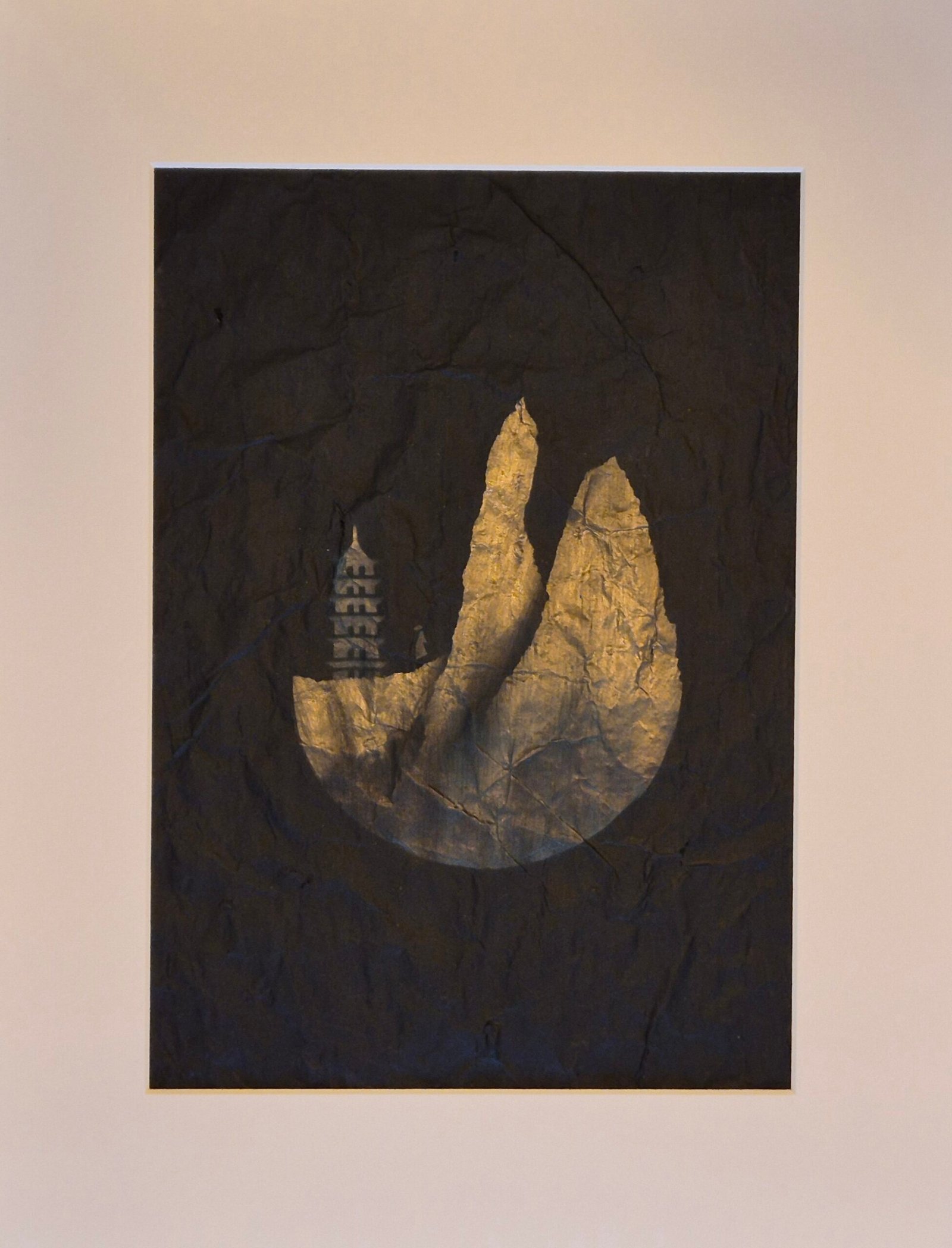
Brass and chemically corroded copper — verdigris patina
Each work begins with a decision about what the ground will do. Brass leaves a warm yellow register; steel produces a cooler, harder grey; reddish copper sits between them. Direction, pressure, and density of deposit are the variables. There is no underdrawing. The surface is built up in passes, each one responding to what the last produced.
The deposited metal does not reflect light uniformly. Direction, pressure and density create areas that respond differently to changing viewpoints and illumination. As a result, the image shifts as the viewer moves. Different forms emerge, recede, brighten or disappear depending on where the work is seen from.
The result shifts with the angle of light — not through any optical device, but because reflective and non-reflective materials sit side by side across the same plane. The same painting reads differently in morning light and in the evening, from the left and from the right, and depending on where the viewer stands or sits. Move across the room and the surface changes.
It also continues to change over time. The metal transforms slowly — not deteriorating, but continuing. Over months and years, the surface moves into a later state. Anyone who lives with one of these works lives with something that is still in motion.
50× magnification — brass particles on dry acrylic
200× magnification — brass particles on dry acrylic
Entropy is one expression of transformation. Not loss. Not decay. A turning toward a different state.
Cultural heritage conservation works to slow that movement — to hold a material in its current form a little longer. Alchemy sought to direct it. Medicine extends it. These are all expressions of the same drive: to intervene in a process that is already underway.
Metal particle painting works differently. It does not resist transformation or attempt to direct it. It works with it — depositing materials that will continue to change, using what metal becomes as the medium itself. A career spent on one side of this process — understanding how things transform, working to slow it — produced the conditions to work on the other side.
Nothing holds still. Everything occupies a particular moment in its own transformation. This is also what a civilisation is. What a life is. A brief presence in something continuous — a moment in the flow, neither the beginning nor the end of it. The presence passes. The flow continues.
The works hold that moment, and continue past it. The transformation is not damage — it is the material finding its next state. The work is not finished. It continues after it leaves the studio.
In some works, the compositional logic is in the Shan Shui tradition — mountain-water painting — in which an object is placed against empty space, and that space is understood as active rather than absent. The emptiness is not unfinished. It is the field in which the form exists.
The object is not set against a background. It is a presence within something continuous — the way a moment exists within a flow that was there before it and continues after. The emptiness holds the form. What is not painted is as deliberate as what is.
Where this applies, the metal particles occupy part of the surface. The rest breathes. The relationship between particles and ground is the composition. There is no background — only the field, and what has settled on it.
The Tao is not a concept applied to the work. It is the condition the work already inhabits.
It is the continuous movement of matter, light, and time — the state in which form appears briefly, stabilises for an instant, and then shifts again. Nothing stands outside this flow. Nothing interrupts it. Every material is already inside transformation.
These works do not represent this condition. They participate in it.
The metal is not fixed at the moment of completion. Light activates different states across the surface; humidity and oxidation continue to adjust the material over time. What is seen is always provisional — a momentary alignment between observer, object, and environment.
In this sense, the work is never finished. It is only temporarily held.
What persists is not form, but change.
“The metal resolves into an image only under real and moving light; the painting is only seen in full by whoever moves in front of it.”